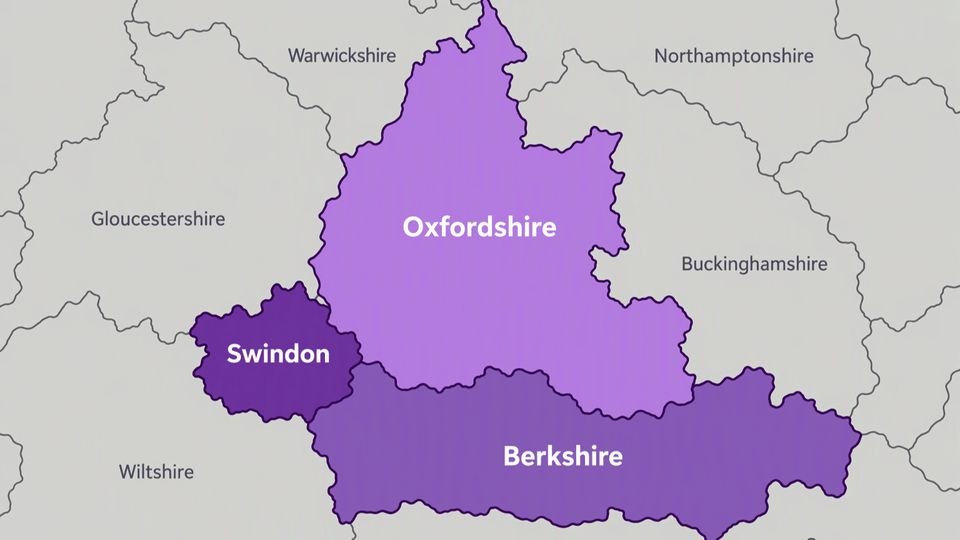
Now that the dust has settled a little on the Government’s announcement of the creation of a Mayor for Thames Valley it’s time to think about what this might mean in the real world.
The sell from the Prime Minister is more money, economic growth and local control - what is not to like? But is that the reality?
From the shape on the map to where the money is coming from, I have my doubts.
As Police & Crime Commissioner for Thames Valley, I have a very fixed view on the geography of the area called Thames Valley. I appreciate that makes me unusual, most people don’t know, or care about the boundaries of the police area they live in. The Diocese of Oxford is the only other organisation that covers exactly the same areas - Oxfordshire, Berkshire, Buckinghamshire and Milton Keynes.
So does geography matter? What the Government are calling Thames Valley is Oxfordshire, Berkshire, Swindon (and possibly Buckinghamshire) at a later date. I know from my own experience as PCC that the public do not identify with these large areas, and the addition of Swindon seems largely politically driven. In policing perhaps it does not matter too much, but I do believe that if one person - the mayor - is to be elected to be responsible for important issues such as housing and transport infrastructure, that there should be a sense of identity. Surely the Mayor needs to be able to have a coherent vision for the whole of Thames Valley, rather than combining disparate council areas that have little in common. In places like Greater Manchester, the West Midlands or London there is a much clearer sense of place. If people do not know what Thames Valley means now, with a uniformed organisation, Thames Valley Police, that has existed for more than 50 years, will they identify with a new thing called Thames Valley that someone has simply drawn on a map in Whitehall?
In particular is the question of what the shape of this new area means for other parts of the public sector. The NHS has recently been through a process of changing it’s own boundaries to create the Thames Valley Integrated Care Board. This only came into being in April of this year, and yet it does not match the new Thames Valley that the Government is now talking about.
I have already mentioned Thames Valley Police, but these changes are happening alongside a programme of change in the Home Office which also threatens a change to geography. The ideal, set out by the Government, of having all local services aligned geographically is an attractive one - but it is challenging. The inclusion of Swindon and exclusion of Milton Keynes from the new jigsaw of local government makes it much more likely that costly and distracting restructuring of both the police and the NHS will soon follow.
So why are Lib Dem and Labour council leaders so clean to sign up to the plans when some of them already acknowledge the problems this will cause for other parts of the public sector? Money seems to be at least part of the answer. In the short term local leaders will receive £9.1m in capital funding as part of the Good Growth Fund. I acknowledge that this is only part of the package that might be available, but to put that figure in context, it would buy about 72cm of the Botley Road bridge!
In the Chancellor’s budget statement he said that Mayors would receive both business rates receipts from their local areas and a proportion of income tax receipts. This sounds like a bonanza of local investment, but will it really be as exciting as it sounds? None of these measures directly generate any more income for the state. Of course we all hope that growth will help to grow the size of the pie, but at the moment the Government is just passing the money around. As local government (with or without a mayor) raises more money locally, central government will withdraw funding centrally. The Prime Minister has heralded the fact that mayors will be able to borrow against this tax income, but this is simply moving central government borrowing off the books! The Treasury will see self-funding local government as a way to cut costs, and the Government can claim to have reduced the burden of public sector borrowing. The financing of mayors is simply smoke and mirrors.
And what about consent? Locally no-one has asked for a Mayor for Thames Valley. Where referendums have been run elsewhere in the country, the majority have been rejected by the public. There are genuine concerns about rural areas being left behind and ignored. Even within the existing county of Oxfordshire, there are many who feel that the city sucks in more than it’s fair share of resources and attention, but how will rural towns and villages feel when they have to compete against not just Oxford, but also Swindon, Reading, Bracknell, Slough and Windsor?
I am not completely opposed to mayors as a matter of principle. The benefit of clear accountability and political direction is real, but does it meet the cost-benefit threshold? If the government wants to devolve cash and powers to local government, why not provide that to existing councils? If councils are inefficient then abolish them. What is being created is a more complicated structure, councils are not being replaced, but more tiers are being added.
If the Government press ahead with these plans - and there is still some uncertainty - then I wish the new Mayor. I want our local economy to thrive and I absolutely see the benefits of local accountability. My fear is that the reality will be passing costs and debt onto local government and the artificial lines on the map make it incredibly difficult for someone to create a convincing narrative for the people we are all here to serve.